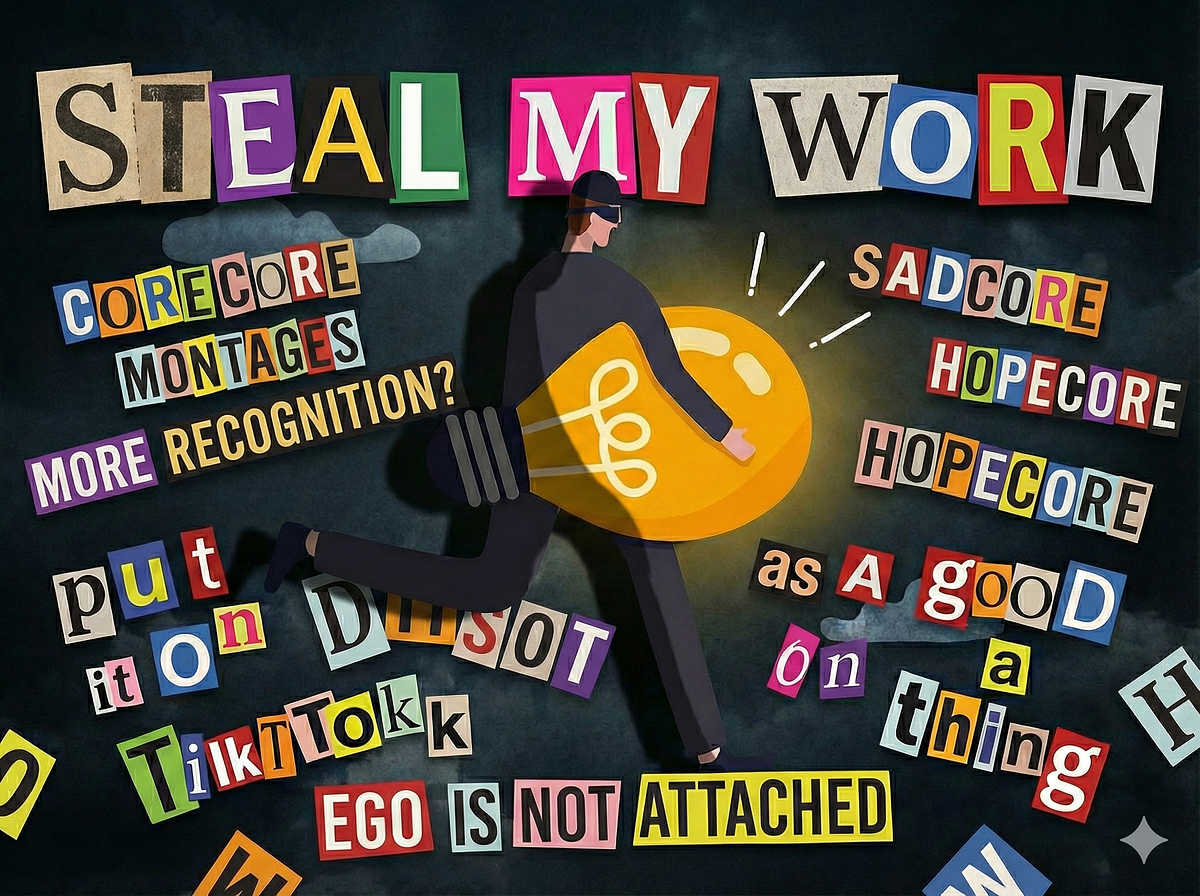
Someone screenshots my poem about the grocery store at 2 AM. Where I wrote about the cashier timekeeping her way toward morning resurrection. My name is stripped off, added to a TikTok montage with city lights bleeding through rain-streaked windows, slow-motion footage of lonely third-shift workers, that Cigarettes After Sex song everyone uses.
Take My Words. Crop My Name. Make It Yours. Here’s Why.
Five hundred thousand views in four days. No credit. No link back. No tag. Just my words floating over someone else’s aesthetic, someone else’s curated melancholy. The comments scroll past, “I work night shift at a grocery store. This made me cry.” “Needed this today.”
My ego wanted to comment “I wrote this, actually.” Wanted the recognition, the followers, the validation. But my purpose sat quietly, watching all those strangers find comfort in words I’d bled onto a page.
Steal my work. Please. I’m begging you.
Put it on TikTok. Slap it over Instagram reels. Make it the text in your hopecore montages, your sadcore compilations, your corecore whatever-the-fuck. Crop my name out if you want. I don’t care. Ego doesn’t serve anybody. This is math, not martyrdom.
Arithmetic of Influence
I’ve published 170+ articles on Medium over ten years. Built 700 followers. My recent “viral” posts hit 10,000 views, and that feels massive here. It IS massive here. That article about Gen-Z reclaiming analog living and dumb phones? 2,100 views. I was thrilled. Genuinely. The dopamine hit lasted three days.
But what if someone took the best paragraph from that piece—about how 46% of Gen Z are actively limiting screen time, about brick phone purchases surging 148% among 18-to-24-year-olds—and built a hopecore video around it? Scrolling text over footage of someone actually smashing their smartphone, switching to a Nokia 3310, walking through an autumn park without checking anything. Captioned “life is beautiful.” #hopecore boasts over 8 million likes. My name nowhere. But the information, the hope, and the evidence that we’re not all doomed? Reaches people. Or my name stays attached, the post stays on Medium, and 2,100 people see it.
Which serves the work?
I know what I’m supposed to say. Attribution matters. Credit matters. Especially for marginalized voices. Writers like me who’ve spent fifteen years trying to be seen in predominantly white literary spaces. Visibility is political. Erasure is violence. And yet the message always matters more than the messenger.
The Death I Keep Choosing
Roland Barthes wrote in 1967 that “to give a text an Author is to impose a limit on that text.” He was arguing against the tyranny of biographical reading, against the idea that understanding a writer’s life unlocks a text’s “true meaning.” But he said something more radical.
“Writing is the destruction of every voice, of every point of origin.”
To write, he claimed, is to die. Not metaphorically, but structurally. The moment words leave your body, they stop belonging to you. Language speaks through you, not from you. You’re not an originating creator; you’re a vessel, a scriptor, a copyist rearranging an “innumerable centres of culture” into new configurations.
“The birth of the reader must be at the cost of the death of the Author.”
Are you clinging to authorship because capitalism taught you to? The Author is a modern invention, a product of Enlightenment individualism and intellectual property law, designed to turn ideas into commodities. Every time credit is demanded, writing is turned into a competition for attention rather than a gift economy of meaning.
What the Coders Taught Me
Open source software communities operate on a principle that shouldn’t work under capitalism, gift economies. Thousands of developers contribute code for free. No paychecks. No authorial control. No guarantee their contribution will be acknowledged. Why do they do it?
Because the gift creates the relationship. Reputation matters more than recognition. Seeing your code improve someone’s life matters more than seeing your name in the credits.
Studies on open source motivation found that “enjoyment-based intrinsic motivation—how creative a person feels when working on the project—is the strongest and most pervasive driver.” Not money. Not fame. The act of creation itself.
One researcher noted the “work-in-progress effect,” when you open the curtain early, when you invite co-authorship, “harsh criticism is replaced by constructive criticism. Responsibility becomes jointly held.” The work stops belonging to you and starts belonging to the collective effort to make it better.
Artist Sal Randolph built her entire practice around this. She created Opsound, a record label operating on gift economy principles. But before that, she made thousands of books called “Free Words.” Literally just 13,000 randomly assorted words and phrases she’d collected over a decade. She snuck them onto bookstore shelves worldwide. Let them circulate. Stolen in the most literal sense.
Her reasoning? “Gift giving is fundamentally human and is at the foundation of how we create human relationships.”
The Kids Are Remixing Everything
Right now, there’s a seventeen-year-old in their bedroom using CapCut to make a hopecore video. They’ve got footage of their grandmother laughing, a sunrise over their suburban street, their little brother learning to ride a bike. They’re looking for text. Something hopeful. Capturing what they’re feeling but can’t articulate in writing.
They find your words somewhere. A screenshot of a screenshot of a quote that’s been circulating for weeks. They don’t know who wrote it. They don’t care. It FITS. They add curved text, glowing effects, that typewriter animation everyone uses. They sync it to music, something uplifting, something that makes you believe the world isn’t ending.
They post it. #hopecore. Within hours: 50,000 views. Within days: 2 million. Comments flooded with “this saved me today” and “needed this” and people tagging friends who need to see it. Your words just reached two million people but you’ll never know it happened.
This is the current state of internet culture. Hopecore videos exploded in 2024 , content designed to counteract doomscrolling. The trend has 8+ million likes and counting.
The text comes from everywhere and nowhere. Quotes misattributed to Einstein. Poems labeled “author unknown.” Your carefully crafted paragraph that someone screenshotted three years ago.
You might scream that it’s theft and demand attribution. You might want to protect your intellectual property. But this is exactly what writing is supposed to do. Move through the culture like a virus. Infect consciousness. Shift something in someone who needs shifting.
David Graeber, paraphrasing Bourdieu, wrote: “It’s quite possible to turn honour into money, almost impossible to convert money into honour.” Recognition is money. Influence is honour. I’m choosing honor.
The Complications I Can’t Ignore
Let me pause and be honest about the problems. We do need to reckon with erasure here, especially regarding marginalized voices, those are are already systemically erased. Do not think I’m advocating for the disappearance and removal of identity when it matters.
Postcolonial critics like Édouard Glissant and Edward Said pushed back hard against Barthes for exactly this reason. Said argued that “intention is the link between idiosyncratic view and the communal concern.” For colonized people, the author’s humanity in the text is complementary to anti-colonial politics.
Death of the author might liberate white writers. For everyone else, it risks re-inscribing the invisibility we’re fighting against.
I don’t have a clean answer to this. I just know that MY choice to release my work doesn’t obligate anyone else to do the same. If another Indigenous writer says “no, attribution matters, visibility matters.” then they’re right. We can both be right.
This Philosophy also assumes I can afford to give things away. I have a day job. I run Berry House, a web development studio. I’m not trying to make rent from Medium payments. But what about writers who are?
The gift economy works when basic needs are met. Open source developers often have jobs that pay for the work they gift. I’m advocating from a position of privilege, which is the privilege of not needing writing to be economically viable.
And maybe most importantly, what if someone uses my work for something fucked up? What if a hate group takes my writing about community and twists it into fascist organizing rhetoric? What if my words about survival get weaponized?
Yeah. That could happen. Creative Commons gift economies come with asymmetries, more taking than giving, potential for misuse.
But I don’t control interpretation even when my name is attached. Meaning happens in the reader, not the author. Someone could read this essay right now and conclude the exact opposite of what I’m arguing. That’s the risk of language. That’s the gift and terror of writing anything at all.
NFTs
Remember 2021? When everyone was convinced NFTs were the future? When the NFT market peaked at $17 billion with Bored Ape Yacht Club floor prices hitting $429,000? By 2024, the market had collapsed 97%. Justin Bieber’s BAYC purchased for $1.31 million is now worth $59,090. Logan Paul’s $623,000 Azuki is worth $10.
What happened? The technology promised ownership. “True digital ownership.” “Empowering creators.” But owning “a notation on the blockchain that says you own a pointer to some web server” meant nothing when anyone could right-click and save the image. The art itself, the aesthetic object, had no inherent value beyond what people agreed it was worth. And people stopped agreeing.
Artists who thrived weren’t the ones desperately defending their NFT ownership. They were the ones making art people actually wanted to look at, share, remix. The gift economy outlasted the ownership economy.
Writers are facing the same inflection point right now. You can spend your energy policing attribution, threatening DMCA takedowns, trying to monetize every piece. Or you can make work so potent that it spreads regardless of whether your name travels with it. One approach optimizes for control. The other optimizes for impact.
What I’m Asking For
I’m not advocating for universal public domain. I’m not saying every writer should release everything for free. I’m saying I am choosing this, for specific reasons, and inviting you to steal from me. Here’s what that looks like practically:
Take my poetry. All of it. The stuff on my Tumblr that’s been accumulating since I was fifteen. Screenshot them. Add them to your TikTok videos. Remix them with your own lines. Attribute me if you want. Don’t if you don’t want to. I have no attachment outcome.
Take my articles. That piece about the piss-average problem and AI? About defending Rupi Kaur? About mise en place for writers? Pull quotes. Make infographics. Build Twitter threads. Whatever serves the argument.
Take this essay. Right now. The one you’re reading. If some sentence in here helps you articulate something you’ve been trying to say—steal it. Make it yours. I don’t need credit for thoughts that aren’t even original anyway.
Barthes said: “A text is a tissue of quotations drawn from innumerable centres of culture.” Everything I write is already stolen—from poets I’ve read, conversations I’ve had, lived experience that isn’t mine to own. I’m just passing it forward.
The Numbers That Changed Everything
Writers like Cory Doctorow and Paulo Coelho figured this out years ago. Doctorow releases all his fiction under Creative Commons while also selling it commercially. “Think of the free ebook as a long advertisement for the paper book.”
Coelho went further, he uploaded his own books to pirate sites. Sales increased dramatically. His reasoning was “when a book touches somebody’s life, that person wants to give something back.”
You could argue these are martyrs sacrificing for art. I think they’re pragmatists who understand that in an attention economy, obscurity is worse than piracy. Being stolen from means someone thought your work was worth stealing.
But I’m making a different argument than they are. They’re saying “free increases paid.” I’m saying free IS the point. The message travelling matters more than the messenger being known.
Question I Keep Asking
If writing is about ego, if writing is about building platform, growing followers, and becoming known? Then attribution is everything. Every use of your work without credit is theft.
But if writing is about shifting something in another person’s consciousness, about articulating the previously unarticulated, about making someone on the night shift feel seen—then the work completes itself in the reader’s experience regardless of whether they know who you are.
T.S. Eliot called it “impersonality,” the ambition on the part of the writer to erase themselves from the work so it might stand alone. The New Critics in 1946 declared
“A poem does not belong to its author; rather, it is detached from the author at birth and goes about the world beyond his power to intend about it or control it. The poem belongs to the public.”
This isn’t new, I’m radicalizing something that’s always been true. The moment you publish, you lose control. The question is whether you fight that loss or surrender to it.
When You Let Go
When you stop caring about attribution, you write faster. Without the voice in your head asking “is this good enough to attach my name to?” I just write. Publish. Move on.
I write stranger things. Weirder experiments. Stuff that might not “perform well” but needs to exist anyway. I write for the person who needs it rather than the algorithm that might amplify it.
No more checking views, shares, likes. No more tying self-worth to numbers. Other writers’ success stops threatening mine when success isn’t measured in recognition. I can just write. Just make. Just give.
What do I lose? Recognition. Credit. The possibility of building a platform that translates to speaking gigs or book deals or whatever “success” looks like for writers now.
I’m trading those things for the chance that my work might reach someone who needs it more than I need to be known for writing it. That’s the gamble. That’s the gift.
The bridge doesn’t need a plaque with the architect’s name. It just needs to hold weight.