My dad told me that his step-father, Robert Matsyk, was a news editor at the Winnipeg Free Press decades ago. He’s proud of me for getting into this line of work—for sinking my teeth into literary journalism. For the fact I’m writing good work that people read.
And I can’t help but think of what Bob was doing—what his daily workflow looked like and what journalism really meant to him. The entire field and industry of journalism decades ago intrigues me. It’s a ghost now, isn’t it?
Indulge me for a moment. Let’s get romantic about a problematic time period, fully aware of its systemic flaws and horrors. As a nonfiction writer, I admit I often fantasize about being born a few decades earlier, to a time when journalism was still a stable, impressive industry.
Newsroom Symphony
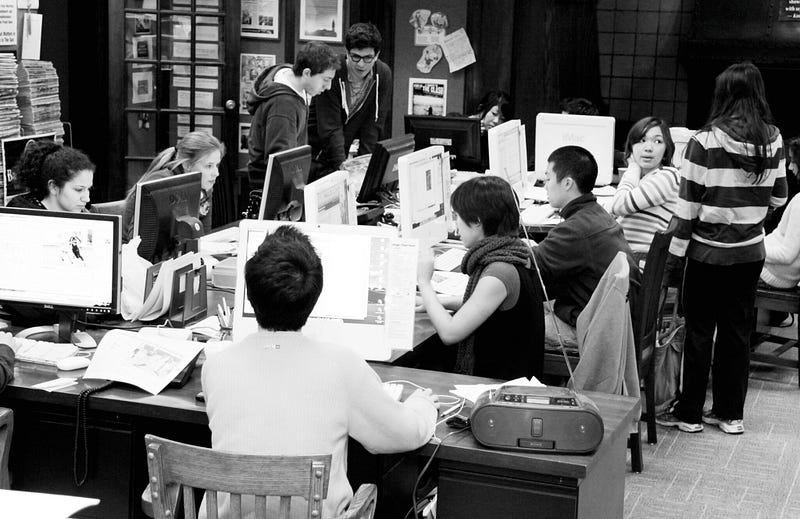
Imagine the cacophony of perhaps ten Teletype printers chattering away, their mechanical fingers tap-tap-tapping out bulletins from distant bureaus. Five bells meant something somewhat important. Ten bells, a flash!, and the entire newsroom would freeze, every head turning toward the machine like sunflowers to sudden light. The sound of manual typewriters clacking in rhythm, each keystroke a percussion. The satisfying ding! of the carriage return bell, the metallic zip! as reporters yanked paper from their machines and tore it against a ruler’s edge.
Chemical smells drifted from darkrooms. Police scanners squawked urgent codes. Phones rang. Actual corded landlines which couldn’t be silenced or ignored. Bells as insistent as alarm clocks. Reporters shouted across desks, booming voices competing with the low rumble that started deep in the basement as the printing presses awakened. The entire building to tremble as deadlines approached.
There was never dead silence in those newsrooms. I’m not the only one romantic about this, The London Times tried piping in typewriter sounds through speakers in 2014, hoping to recapture that lost energy and electric urgency that came from dozens of people simultaneously chasing truth with their fingers.
The Texture of Low-tech, Analogue Work
I love computers, don’t get me wrong. But we really only need so much, don’t we? Take a look at the writerDeck community. A writerDeck is a device dedicated specifically and solely to writing, such as the Astrohaus Freewrite or the Alphasmart Neo. A group of people are now dedicated to creating and using single-use writing devices because our default devices now are too overstimulating and distracting.

Twenty or thirty years ago, all computers were writerDecks. Sure, the Internet existed and there were definitely ways to waste time (Solitaire, anyone?). By the 1980s, most reporters had desktops of their own, clunky machines that did one thing well. They let you write.
And if I’m being honest, I think people should have the discipline to write even with the entire Internet at their fingertips. I still get up each morning and write my 750 words. putting on my playlist full of midwest emo instrumentals and just focus on my fingers on the keys. Anybody can do this.
But regardless, the writerDeck is such a temptation. To be able to go back in time, to have something that is as easy to write with as typing, instead of writing everything by hand. Again, don’t get me wrong—I love writing by hand and analogue methods, but for longform work, my hand will cramp and I will be in pain. I never learned how to write properly and it shows.
It’s not just the writing experience, though. There’s so much more.
Truth-Seeking Infrastructure
There used to be massive newsrooms full of people trying to find the truth and the story. Sure, a handful of these still remain, but they’re so few and far between, and they’ve been compromised. The Washington Post is owned by Amazon and Jeff Bezos, for fuck’s sake.
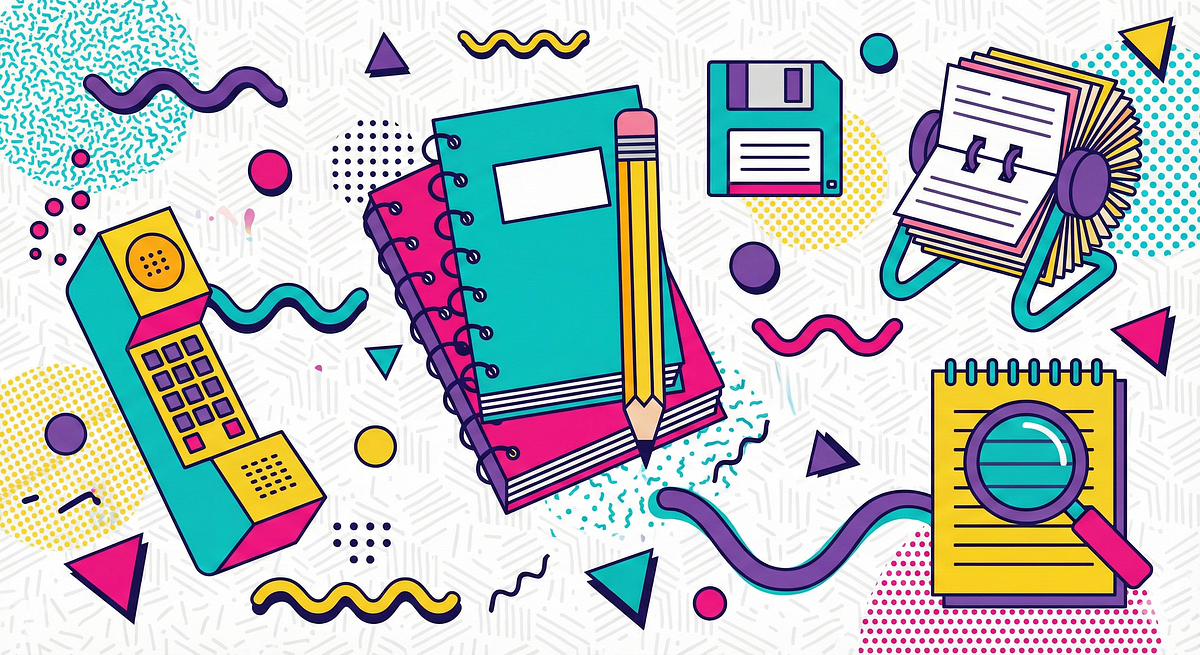
Take us back. I want to have to fax information—to hear that screech-hum of the machine, to watch the thermal paper curl as it emerged, warm to the touch. I want to call on a corded landline to get interviews, to have to travel to get the story, to accumulate plane tickets and hotel receipts and taxi vouchers in a big envelope from the travel desk. I want huge metal filing cabinets instead of unlimited cloud storage. I want to hear the satisfying thunk! of a drawer closing on months of research. I want three-ring metal binders and floppy disks clacking against each other in a desk drawer.
Once again, convenience has paved the way for the total collapse of the meaningful, slow work.
It’s a silly fantasy, of course. It’s important for me to disclaim and concede that a lot of this is still available to do. So sure, maybe in another world, where I was born earlier, and I was more of a traditional journalist. But then what? I grow old and see my industry collapse? The future always inevitably arrives. Such a fantasy is living in a bubble, in a distilled frozen time.
Slow Journalism in a Fast World
We don’t have to completely surrender to the speed and convenience of modern technology. The methods of those 80’s and 90’s journalists and the Philosophy behind them can still inform our work today. There’s an opportunity to reclaim intentionality somewhere in this nostalgia.
Slow journalism, as media scholars now call it, is a movement that takes its name from the slow food movement. Emphasizing openness and transparency, laying bare to audiences its sourcing and methods, it measures reporting time in months or years rather than days. And most importantly, it provides a complement and corrective to a constant stream of updates and breaking news, where amid the pressures of ever-present deadlines, fake news and conjecture often replace reporting.
Here’s how you can write like a 90s journalist today. Combining low-tech/analogue intentionality with modern tools:
1. Embrace the Physical Notebook
Modern journalists still swear by reporter’s notebooks for good reason. When you start writing notes, people feel the productivity, and it becomes a visual cue to keep talking. But if you slow down your notes or completely stop, it signals to an interviewee to steer back on subject.
Action Step: Invest in a quality reporter’s notebook (Field Notes, Blackwing, or Write Notepads all make excellent ones). Carry it everywhere. Date each page. Take notes about how places look, smell, sound. Don’t write everything down, you’re not a court reporter. Write down the quotes that matter, the sensory details you’ll forget, the observations that surprise you.
Pro tip: Develop your own shorthand system. Drop vowels, create symbols for common words in your beat. One reporter uses “C” for whatever their current topic is. It’s faster than typing and forces you to really listen.
2. Create Deliberate “Friction” in Your Process
The beauty of analogue journalism was the productive friction. You couldn’t instantly Google something. You had to call sources, visit libraries, conduct actual interviews. This friction led to deeper, more unexpected discoveries.
Action Step: Before you Google, stop. Who could you talk to instead? What primary source document exists? Could you visit the place you’re writing about? Create rules for yourself: for the first week of researching a story, no Wikipedia. Only interviews, observation, and primary sources. Use the Internet as verification, not as your starting point.
3. Practice the Art of Deep Listening
One reporter describes using a notebook and pen specifically because it creates voids that interviewees feel obliged to fill. If they finish what they were intending to say, and you don’t immediately come back with another question because you’re scribbling down their words, they’ll often just keep going and say things they might not have wanted to say.
Action Step: In your next interview, bring a notebook instead of a laptop. Turn off all recording devices for at least one interview a month. Force yourself to listen so intently that you can write the story from memory if needed. Use a highlighter later to mark the juiciest quotes in your notes.
4. Build Your Physical Archive
Those metal filing cabinets were storage, yes. But they were a physical manifestation of your beat, your expertise. Opening a drawer meant seeing years of work at once, being able to cross-reference stories, to see patterns.
Action Step: Create a physical filing system for your most important projects. Print out key documents, interviews, and photos. Put them in folders or binders. Yes, also keep digital backups, but make the physical version your primary reference. The act of filing something, of physically organizing it, helps your brain make connections that scrolling through a cloud folder never will.
5. Write to a Single Deadline, Not Continuous Deadlines
In the 80s and 90s, newsrooms had distinct energy cycles. The sounds of typewriter bells increased, voices got louder, and tempers grew shorter as deadlines neared. Then—silence. The paper went to press. The work was done.
Action Step: Instead of constantly posting, tweeting, and updating, work in sprints toward single, major publication deadlines. Give yourself two weeks, a month, three months to report and write one substantial piece. Abandon tight deadlines in favor of time-consuming research and the writing of longer-form narratives. Experience that crescendo of energy, then the satisfaction of completion.
6. Develop an “Immersion” Practice
The best slow journalism involves what scholars call “reorientation,” a temporal tipping point where, through the experience of immersion, you abandon preconceptions and develop a situated point of view. Journalist Paul Salopek walked alongside Syrian refugees for weeks, he wrote how “everyone is going faster and faster and getting shallower and shallower. I said, ‘How about we slow down a bit to grab a little mindshare by going in the opposite direction.’”
Action Step: For your next major project, commit to being physically present for an extended period. Not a day and not a few hours. Weeks. Live in the world you’re writing about. Report on the quotidian and non-urgent stories, the everyday rhythms. Let yourself be surprised by what you find when you’re not rushing to the next thing.
7. Type Your Notes Immediately
This was gospel in the 80s and 90s: As soon as you got back to the office, you typed up your notes while you could still hear the person’s voice in your mind. You remembered things you didn’t write down. You could still decipher your scrawls.
Action Step: After every interview, every observation session, every research trip—type up your notes the same day. Not tomorrow. Today. You’ll remember details you didn’t write down. Your handwriting will still make sense. The story will still be alive in your body.
8. Create Multi-Sensory Records
Editors at the Open Notebook advise:
“If you are writing a book or magazine article where you might want to describe a scene, make sure you take notes at the scene about how the place looks, smells, sounds, etc.”
Action Step: In your notebook, dedicate space specifically to sensory details. What does this place smell like? What’s the quality of light? What sounds am I hearing that I’ll forget in an hour? Take photos not just of people, but of textures, colors, objects. Record short voice memos to capture someone’s cadence, the way they speak.
9. Collaborate Without Competition
In post-Katrina New Orleans, news organizations decided to team up to produce the slower, in-depth journalism their community needed. A radical idea. Non-competition became a practice for producing better work.
Action Step: Find another writer working on a similar beat or topic. Share sources. Share research. Edit each other’s work. In the age of infinite content, there’s no scarcity of stories—only a scarcity of time and resources to tell them well. Help each other tell them better.
10. Be Transparent About Your Methods
Action Step: In your finished piece, consider adding a note about your reporting process. How many people did you interview? Over what time period? What archives did you visit? What surprised you? This transparency builds trust and teaches your readers how good journalism actually works.

Photo by Thomas Charters on Unsplash
The Future Is the Past Is the Future
The newsrooms of the 80’s and 90’s were far from perfect. They were male-dominated, lacked diversity, and perpetuated problematic power structures. The industry was already under pressure as media companies demanded quick profits and began consolidating. The collapse was already beginning, even as those mechanical keyboards and typewriters clacked away.
But the methods—the intentional friction, the physical presence, the deep listening, the commitment to verification over speed—those remain valuable. Perhaps more valuable now than ever.
We can’t go back. Typewriters disappeared from newsrooms in the late 1980s. The news industry has collapsed. There’s a lot that isn’t coming back. But we can choose to work with the same integrity and care. We can choose depth over speed. We can choose to be present instead of perpetually connected.
So yes, keep your laptop. Keep your smartphone. Keep your WiFi. But also get a notebook. Use your hands. Go to the place. Talk to the person. Take your time. Create something that lasts longer than a trend or a news cycle.
Key Takeaways for Modern Writers
- Carry a physical notebook everywhere and date every page
- Create friction in your research process—talk to people before Googling
- Practice deep listening without recording devices
- Build a physical archive for important projects
- Work toward single deadlines instead of constant publishing
- Immerse yourself in your subject for extended periods
- Type up notes immediately while memories are fresh
- Capture multi-sensory details in the moment
- Collaborate without competition with other writers
- Be transparent about your reporting methods
The goal is to use technology intentionally rather than outright reject it. Write with the same thoughtfulness that defined the best journalism of decades past. In our world of information overload, slowing down is a necessity for doing work that matters. Write like the future depends on remembering the past. Because it does.
Brennan Kenneth Brown is a Queer Métis author and web developer based in Calgary, Alberta. He founded Write Club, a creative collective that has raised funds for literacy nonprofits. His work spans poetry, literary criticism, and independent journalism, with over a decade of writing publicly on Medium and nine published books. He runs Berry House, a values-driven studio building accessible JAMstack websites while offering pro bono support to marginalized communities.
Support my work: Ko-fi | Patreon | GitHub Sponsors | Gumroad | Amazon Author Page. Find more at blog.brennanbrown.ca.